
Introducing
The AI Causality Engine
Contextualizing Asset Price Movements
A modular framework designed to integrate with—not replace—your existing infrastructure.
Together, we can explore how causal reasoning enhances risk management, portfolio construction, and forward-looking insights.
The Challenge
Traditional price-pattern models often fail to capture the causal, contextual, and non-stationary nature of markets. As institutional AI adoption accelerates, a new approach is needed.
Information Overload
Investors learn from news only up to a point—beyond which information overload increases risk premia and decision paralysis.
Calculation vs. Cognition
Pattern-matching models identify correlations but miss the underlying causal mechanisms that actually drive price movements.
Black-Box Problem
Opaque AI systems create trust deficits with stakeholders who demand interpretable signals and governance transparency.
The solution isn't more data or faster models.
It's understanding why markets move.
ACE is designed as a meta-layer that enhances your existing data and ML infrastructure—preserving your investments while adding cognitive reasoning capabilities.
From Calculation to Cognition
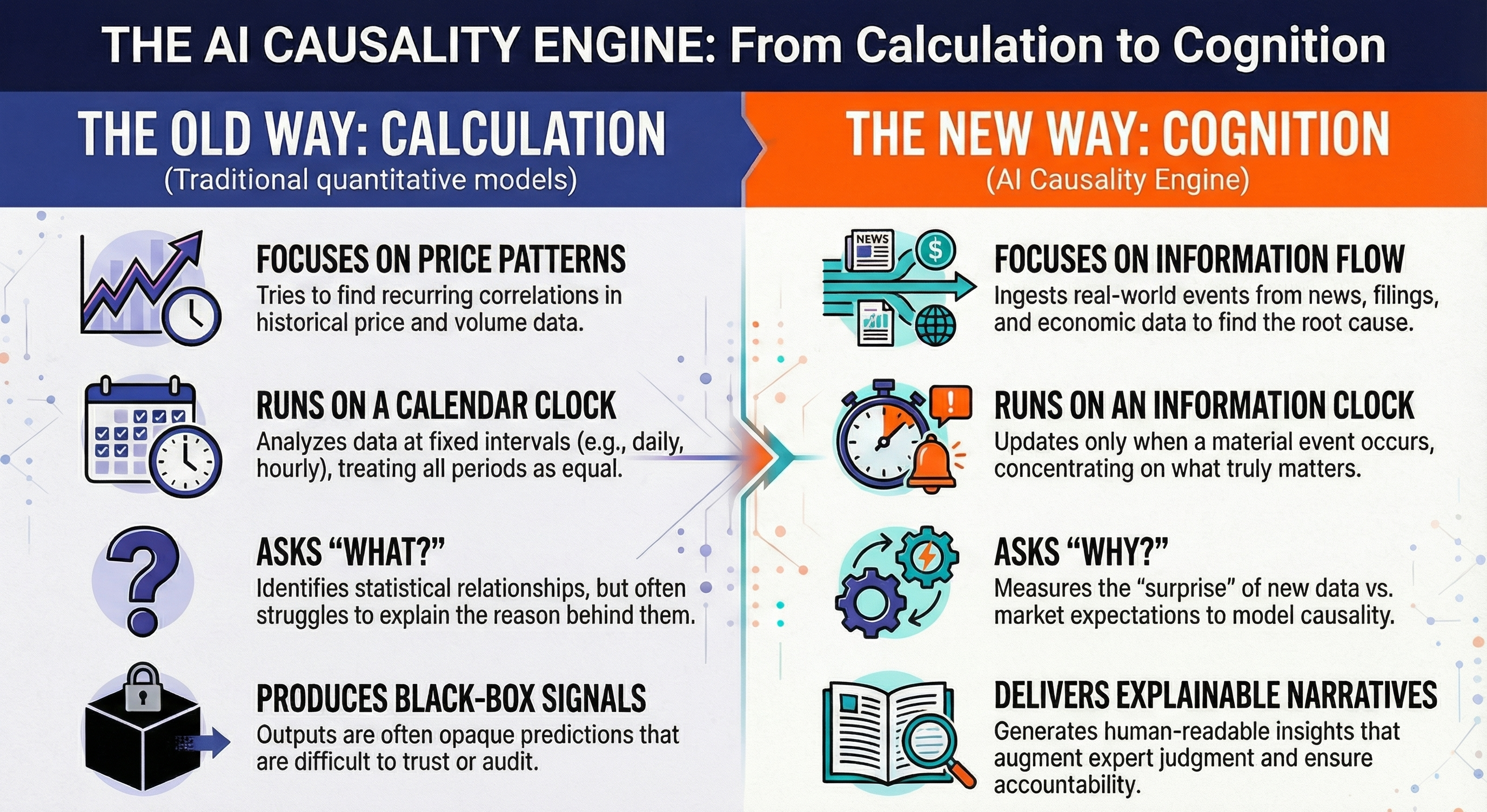
Why It Matters Now
Early Mover Advantage
In 2026, with AI adoption accelerating, early movers gain edges in efficiency and compliance.
Regulatory Alignment
ACE's explainability meets emerging demands like the EU AI Act and fiduciary transparency requirements.
Industry Momentum
Causal AI is disrupting sectors—investments like Accenture's stake in Alembic signal mainstream adoption.
Performance Potential
Research suggests 20-50% improvement in decision accuracy in volatile environments with causal approaches.
ACE Architecture
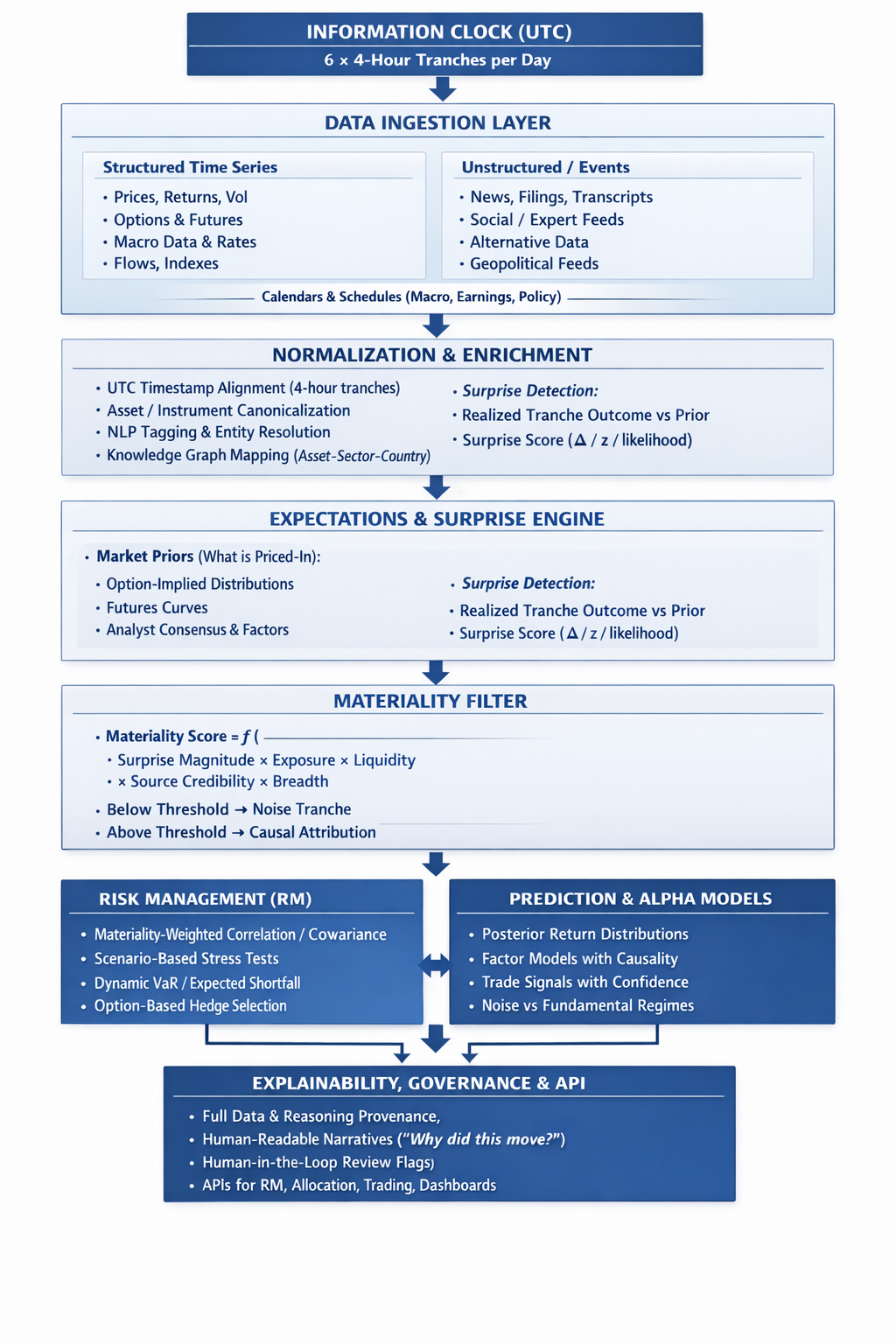
Three-stage processing in four-hour tranches aligned with global trading cycles
Data Ingestion
Structured market data, NLP-processed news, alternative data feeds
Causal Decomposition
Structural Bayesian models linking information flows to returns
Decision Support
Risk analytics, predictive outputs, explainable recommendations
Complete ACE Pipeline
Cognition-First Design
Rather than fitting historical price patterns, ACE ingests real-time information, models expectations and surprise, and surfaces causal pathways to explain market moves.
For each tranche, ACE estimates:
Return Attribution = f(Macro, Sector, Idiosyncratic)
Core Principles of Causal AI
The foundational concepts driving ACE's cognition-first approach
Information Flow as Causality
Markets move on new information relative to expectations. Prices are effects, not causes.
Example: Earnings beats drive reactions based on delta from consensus, not absolute values.
Technical Regime (No Causal Signal)
When no material causal explanation exists, ACE routes to technical analysis: RSI, MACD, momentum, support/resistance, options mapping, and strike-pin risk.
Don't force spurious attributions—use the right tools for pattern-driven regimes.
Expectations, Surprise & Materiality
Prices embed futures; surprises impact only if material. Score by magnitude, exposure, and liquidity.
Estimate priors via options/futures; filter by significance threshold.
Human-AI Synergy & Interpretability
AI handles scale and speed; humans provide judgment, oversight, and accountability.
Outputs as auditable narratives build trust. Mitigate risks with RAG and overrides.
Causality outperforms correlation. AI must trace movements to economic and narrative roots to avoid fragile strategies in reflexive markets.
Four-Tier Attribution Framework
G/I/A for causal regimes, T for technical regimes when no material cause exists
Global Macro
Broad forces affecting many assets via risk premiums or capital flows.
- • Central bank actions
- • Geopolitical events
- • Commodity shocks
Industry / Asset-Class
Sectoral developments and asset-class specific factors.
- • Sector earnings
- • Regulatory changes
- • Industry flows
Asset-Specific
Idiosyncratic causes after accounting for broader factors.
- • Earnings surprises
- • Credit events
- • M&A activity
Technical Regime
When no causal explanation exists, route to technical drivers.
- • RSI, MACD, momentum
- • Support/resistance
- • Options & strike-pin
Causality where it exists; technicals where it doesn't. ACE never forces spurious attributions—when materiality is below threshold, the system routes to pattern-driven modules that reflect how professional traders actually behave.
Integrated Data Sources
Fusing structured, unstructured, and alternative data streams
Structured Market Data
- → Tick and bar prices, volumes, order-book depth
- → Realized and implied volatility
- → Macroeconomic time series (GDP, CPI, yields)
- → Cross-asset derivatives data
Unstructured News & Documents
- → News wires and financial media
- → Regulatory filings (10-K/Q, central bank minutes)
- → Corporate announcements and transcripts
- → NLP-extracted entities and sentiment
Alternative Data
- → Satellite imagery (retail, infrastructure)
- → Shipping AIS and supply-chain trackers
- → Credit-card spending indices
- → Web traffic and social sentiment
Alternative data often leads official statistics by weeks or months.
Key Outputs
Risk management analytics and predictive decision support
Risk Management
-
Regime-Specific Covariances
ΣG, ΣI, ΣA, ΣT estimated per regime and dynamically blended based on information flow
-
Scenario-Aligned Stress Tests
Stress matrices sourced from regime-specific covariances matching the scenario driver
-
Targeted Hedging by Regime
Index options for global shocks, sector spreads for industry, single-name for idiosyncratic, short-term technicals for T-regime
Predictive Analytics
-
Posterior Return Distributions
Full Bayesian probability distributions updated each tranche, not single-point forecasts
-
Causal Trade Signals
Information-driven signals rooted in cause-effect links, not just momentum or technicals
-
Technical Regime Signals
When no causal driver exists, route to RSI, MACD, options mapping, and strike-pin analysis
Causality-Augmented Covariance
Upgrading risk management by adding the causality dimension to covariance estimation
Traditional Covariance Problem
Traditional Σ is unconditional—it treats all observations equally regardless of information context.
- • Correlations underestimated before shocks
- • Correlations overstated after repricing
- • Pro-cyclical risk estimates
ACE Solution: Regime Covariances
ACE computes conditional covariances by causal regime, then blends dynamically.
- • ΣG for global macro tranches
- • ΣI for industry/sector tranches
- • ΣA for asset-specific tranches
- • ΣT for technical regime tranches
Dynamic Regime Blending
Σt = αGt·ΣG + αIt·ΣI + αAt·ΣA + αTt·ΣT
Weights αt reflect current information flow, upcoming calendar risk, and short-term regime probabilities.
Faster Detection
When global materiality rises, αG increases—RM sees cross-asset risk earlier.
Cleaner Estimates
Exclude or down-weight pure technical tranches for information-bearing correlations.
Aligned Stress Tests
Stress matrices sourced from regime-specific Σ matching the scenario driver.
Targeted Hedging
Different instruments by regime: rates for G, spreads for I, single-name for A, short-term for T.
Explainability & Governance
Transparency and human oversight at every step
| Governance Layer | Mechanism | Fiduciary Objective |
|---|---|---|
| Explainability | Narrative reasoning tags and XAI tools | Transparency for auditors and clients |
| Provenance | Data lineage and version control | Ensuring data integrity and compliance |
| Bias Audits | Fairness testing and source diversification | Mitigating structural or sentiment bias |
| Human Sign-off | Human-in-the-loop approval workflows | Maintaining strategic oversight |
Interpretable by Design
Every attribution is explicitly documented: "10% due to oil shock, 5% due to sector momentum, 85% asset-specific." No black boxes.
Human-in-the-Loop
Risk managers can drill into reasoning, adjust assumptions, and override suggestions. Senior analysts review alerts before execution.
"Putting humans in the loop is the most effective way to address AI's black-box challenge in finance." — Zetzsche et al. (2020)
Strategic Deployment Roadmap
A phased approach to exploring and implementing causal AI capabilities
Education & Scoping
3-6 months
Disseminate principles across teams; inventory existing data and ML systems for integration points.
Pilot Building
6-12 months
Test on specific assets (equities, FX) using open-source causal tools like DoWhy or CausalNex.
Scaling & Governance
12-18 months
Firm-wide rollout with compliance protocols, human-in-the-loop workflows, and audit trails.
Evolution
Ongoing
Monitor metrics like alpha uplift and risk reduction; iterate on emerging 2026+ advancements.
We invite collaboration at any phase. Whether you're exploring foundational concepts or ready to pilot, let's discuss how ACE principles align with your firm's objectives.
Research & References
Supporting evidence and further reading on causal AI in finance
Academic Research
- Principles of AI for Investment Management: From Calculation to Cognition Magny (2025) — SSRN
- Causal Inference for Asset Pricing Haddad, He, Huebner, Kondor, Loualiche — SSRN
- Artificial Intelligence in Finance: Putting the Human in the Loop Zetzsche, Arner, Buckley, Tang — SSRN
- Institutional Trading and Satellite Data Ha (2025) — ScienceDirect
- Correlation Scenarios and Correlation Stress Testing Packham & Woebbeking — ScienceDirect
Industry Reports & Analysis
- Explainable AI in Finance CFA Institute (2025)
- Explaining the News: Why Capital Markets Need Causal AI causaLens White Paper
- Causal AI: How Cause and Effect Will Change AI S&P Global
- AI Investment Research: 2025 Trends Amundi Research Center
- Causal AI Disruption Across Industries (2025-2026) Acalytica
Let's Explore Together
An invitation to collaborate on the future of causal AI in investment management


François Magny
Chief AI Architect, AGI Jesse
With over 30 years at the intersection of derivatives trading, quantitative strategies, and cognitive AI, I'm passionate about helping institutional teams navigate the evolving AI landscape. The ACE framework represents an open invitation to explore how causal reasoning can complement your existing capabilities.
Whether you're evaluating causal AI concepts, considering pilot implementations, or seeking to understand how these principles align with fiduciary responsibilities—I welcome the conversation. Let's explore what's possible together.